
Miss Anne in Harlem
The White Women of the Black Renaissance
Carla Kaplan
544 Pages
On-Sale Date: 02/09/2014
ISBN: 9780060882372
Trim Size: 6.000in x 9.000in x 1.190in
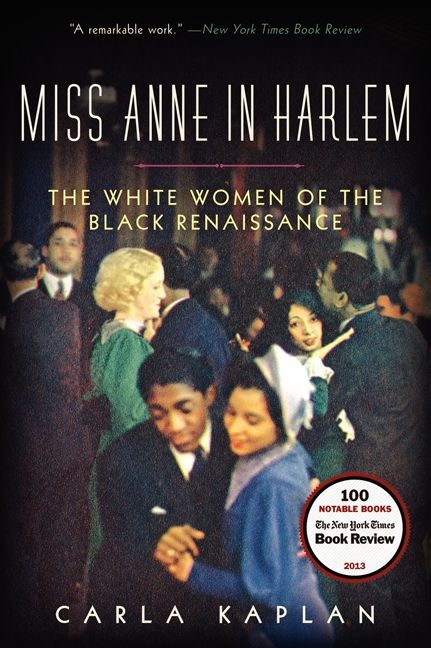
Celebrated scholar Carla Kaplan’s cultural biography, Miss Anne in Harlem: The White Women of the Black Renaissance, focuses on white women, collectively called "Miss Anne," who became Harlem Renaissance insiders.
The 1920s in New York City was a time of freedom, experimentation, and passion—with Harlem at the epicenter of the Jazz Age. White men could go uptown to see jazz and modern dance, but women who embraced black culture too enthusiastically could be ostracized.
Miss Anne in Harlem focuses on six of the unconventional, free-thinking women, some from Manhattan high society, many Jewish, who crossed race lines, challenged concepts of racial identity, and defied social conventions to become a part of the culture and heartbeat of Harlem.
Ethnic and gender studies professor Carla Kaplan brings the interracial history of the Harlem Renaissance to life with vivid prose, extensive research, and period photographs.
This landmark work of social history and women’s studies reveals:
- A Hidden Chapter of Black History: Discover the fascinating story of "Miss Anne," the white women who crossed the color line to become insiders during the Harlem Renaissance, taking on immense social risk to be part of the culture.
- An Unseen Side of the Jazz Age: Explore the complex social dynamics of 1920s New York City, where women who embraced Black culture too enthusiastically faced ostracism and defied convention.
- Compelling Cultural Biographies: The book focuses on the lives of six unconventional, free-thinking women who navigated the exhilarating world of Harlem, challenging ideas of race and gender.
- Meticulous Academic Research: Written by celebrated scholar Carla Kaplan, this definitive account brings an overlooked aspect of American history to life with vivid prose and period photographs.
“Professor Kaplan, a biographer of the writer Zora Neale Hurston, captivatingly illuminates and places in overdue perspective.” — New York Times
“[A] revelatory book. . . . Happily, there’s been so much written on the Harlem Renaissance that the subject seems a bit mined-out; until, that is, a book like Kaplan’s comes along and leaves a reader reeling. . . . Aside from its significance as cultural history, Miss Anne in Harlem is packed with amazing life stories.” — NPR’s Fresh Air
“In this remarkable work of historical recovery . . . [Kaplan] resurrects Miss Anne as a cultural figure and explores the messy contradictions of her life . . . deeply researched.” — New York Times Book Review
“An empathetic and skillful writer, Kaplan . . . shares the previously untold story of a group of notable white women who embraced black culture–and life–in Harlem in the 1920s and ‘30s. . . . Captivating.” — Publishers Weekly (starred review)
“Each biography is shaped by Kaplan’s vivid scene-setting, historical perspective, psychological sensitivity, narrative panache, and frank analysis of the virulent sexism and racism of 1920s America and the confluence in Harlem of grim social conundrums and a spectacular creative flowering. . . . Kaplan’s meticulously documented and intrepid history of Miss Anne encompasses a unique vantage on the complexities of race and gender and a dramatic study in paradox.” — Booklist (starred review)
“In this utterly fascinating and deeply insightful account, Carla Kaplan reveals the disparate women who together became “Miss Anne” in the Harlem Renaissance. From the reticent Annie Nathan Meyer through the manipulative Charlotte Osgood Mason to the flamboyant Nancy Cunard, they could see themselves as better Negroes than actual black people and despise other whites in black milieu. Yet they challenged the meanings of race and gender in ways that still deserve attention. This fine book takes the Misses Anne seriously and goes further, to reveal the workings of interracial networks in one of the most important cultural phenomena in American history.” — Nell Irvin Painter, author of The History of White People
“The fact that white women played a pivotal role in creating the Harlem Renaissance was a secret hiding in plain sight, but it took Carla Kaplan’s keen eye, rigorous research, and crystal clear prose to reveal it. Miss Anne in Harlem is a surprising, delightful book, that will soon be essential reading for anyone interested in the Harlem Renaissance and the brave, bold women of the Jazz Age.” — Debby Applegate, author of The Most Famous Man in America
“Endlessly fascinating, Miss Anne in Harlem reveals a whole new perspective on the Harlem Renaissance, and Carla Kaplan delivers an essential and absorbing portrait of race and sex in 20th century America.” — Gilbert King, author of Devil in the Grove
“Carla Kaplan has taken on a dauntingly liminal topic and by force of scholarly rigor and narrative compassion rendered it central to our understanding of an era. Lush, original, and vigorously argued, Miss Anne in Harlem does justice to the difficult richness not only of these exceptional women’s lives but of life itself.” — Diane McWhorter, author of Carry Me Home
“With superb, exhaustive research and finely dramatic writing, Carla Kaplan’s brilliant Miss Anne in Harlem fills an aching void in our knowledge of the Harlem Renaissance. It also significantly deepens our understanding of American culture in the 1920s and American feminism in general.” — Arnold Rampersad, author of The Life of Langston Hughes
“A work of meticulous and far-ranging scholarship, Carla Kaplan’s Miss Anne in Harlem matches its characters’ shocking and subversive lives with explosive revelations and subtle insights. Kaplan has assembled an unforgettable ensemble cast of race-rebels, ‘traitors to whiteness,’ who gave their full resources-talent, compassion, money, ingenuity-to the cause of black cultural liberation a half-century before America discovered that ‘black is beautiful.’ A story of Harlem Renaissance insiders who would always be outsiders, Kaplan’s haunting narrative forces a rethinking of race and gender.” — Megan Marshall, author of Margaret Fuller: A New American Life and The Peabody Sisters: Three Women Who Ignited American Romanticism
“Smart, sparkling lettters. . . . A fascinating collection” — O, the Oprah Magazine, on Zora Neale Hurston: A Life in Letters
“Kaplan has made the letters remarkably accessible.” — New York Times, on Zora Neale Hurston: A Life in Letters
“ [An] epic collection . . . .The arrival of these letters is like a beacon cast on Hurston’s life.” — Orlando Sentinel, on Zora Neale Hurston: A Life in Letters
“A wonderful addition to what we need to understand about a spirited, extraordinary life.” — Alice Walker
“In these letters we encounter Zora Neale Hurston as if for the first time.” — Henry Louis Gates Jr.
“Kaplan always writes from inside her characters, and with a novelist’s sense of scope—and compassion.” — Hilton Als, New Yorker.com
“(Kaplan’s) extensive research has given life to a critical period in black American history-and given credit to the white women who, for various reasons, helped the Harlem Renaissance flourish.” — NPR.org
“[R]ichly researched, thoughtful new book.” — Boston Globe
“In her clear-sighted, empathetic assessment of a half-dozen of these women, Carla Kaplan casts a fresh eye over people and relationships too often reduced to stereotypes.” — Daily Beast
“[An] intriguing new book.” — Washington Post Book World
“Carla Kaplan has given us and history a great gift.” — New York Journal of Books
“An intriguing slice of long-overlooked American history.” — Christian Science Monitor
Read-Alikes
By Carla Kaplan